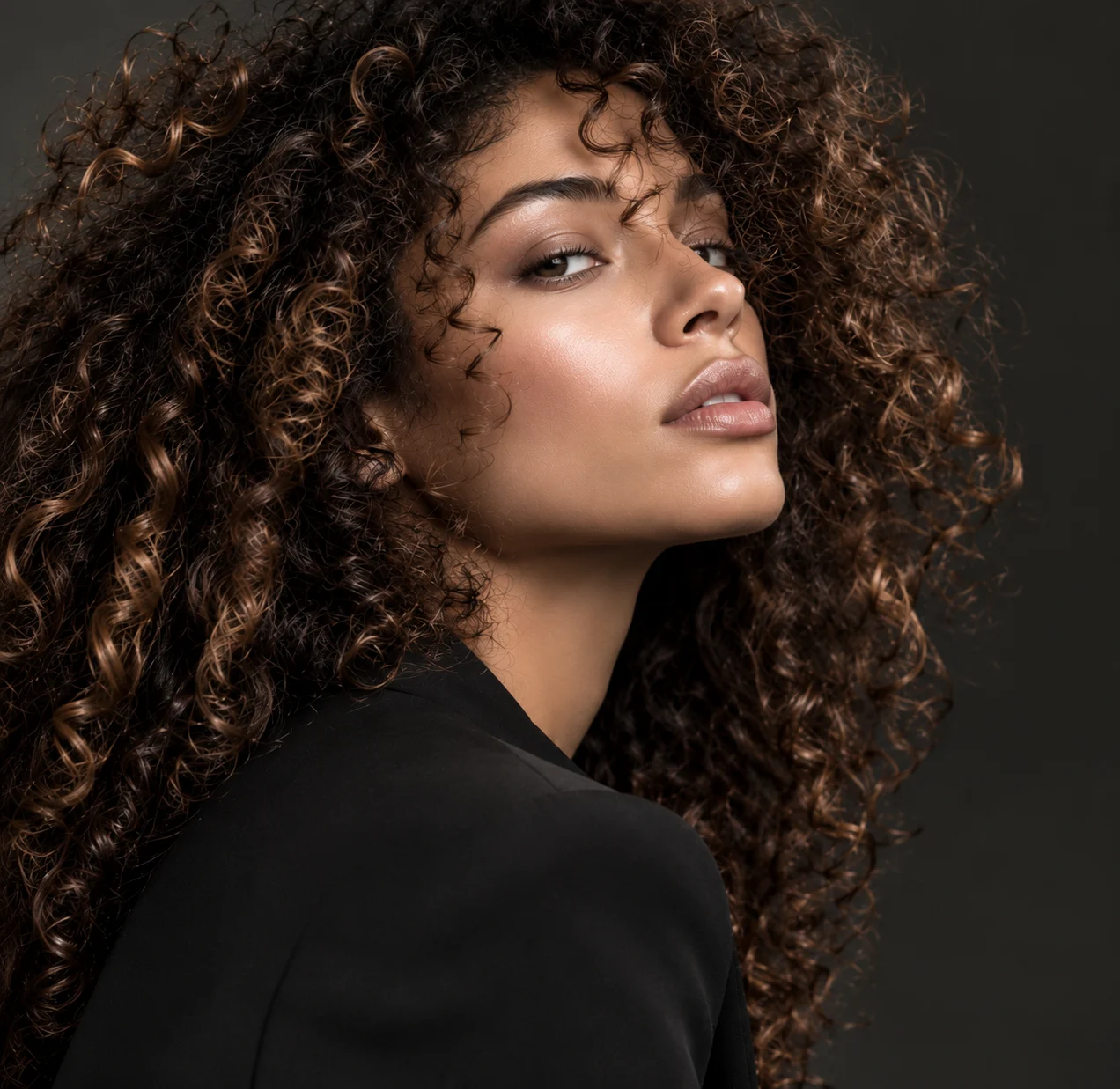
Curly hair is often discussed as though it can be neatly categorised: curly, wavy, coily, tightly curled, softly bent. These descriptions are useful shorthand, but only up to a point. A curl pattern can describe the visible shape of the hair; it tells you very little about how that hair actually behaves.
Two people can appear to have almost identical curls and need completely different things. One may absorb moisture immediately, while another seems to resist it. One may need softness, another structure. One may respond beautifully to a rich cream that leaves the other flat, heavy and overworked. The curl is what you notice first, but what interests me is everything underneath it: the density, the diameter of the individual strand, its elasticity, its porosity, the condition of the fibre, how quickly it becomes wet, how slowly it dries, where it loses moisture and what happens to it several days after it has been styled. That is where textured hair becomes interesting.
Every strand begins beneath the scalp inside the follicle, and in many ways the follicle establishes the architecture of everything that follows. Straighter hair tends to emerge from a more rounded follicle, while curly and coily hair develops from a follicle that is more oval or asymmetrical, encouraging the strand to bend as it grows. The result might be a loose wave, a polished curl or a very tight coil, but the important thing is that the strand is no longer travelling in a straight line. Every turn changes something.
Natural oils produced by the scalp can move relatively easily along straight hair. On textured hair, they have a more complicated journey. Every curve and change in direction slows that movement, which is one reason the lengths and ends can become drier. The ends are also the oldest part of the hair, so it is hardly surprising that this is often where dryness, weakness and loss of definition become most obvious.
This is where the familiar advice begins: textured hair needs moisture. It does, but that statement has been repeated so often that it has almost become meaningless. Moisture does not mean coating every curl in the richest product available. It does not mean that more conditioner is automatically better, or that an oil recommended by someone with impressive hair on social media necessarily belongs on yours.
Fine textured hair can collapse under the weight of products supposedly designed to help it, while hair with a greater strand diameter may absorb the same products beautifully. Highly porous hair can appear to drink almost anything placed on it and still feel dry soon afterwards, whereas lower-porosity hair can leave products sitting stubbornly on the surface. The products have not necessarily failed; the assessment may simply have been wrong.
Porosity is one of those words that has migrated from the salon into everyday conversation, usually accompanied by increasingly elaborate home experiments. At its simplest, it describes how readily the hair takes in and retains moisture. I prefer to observe the hair itself. How does it respond when it becomes wet? How does the surface feel? How quickly does water penetrate? How does it dry, and how long does the result last? Hair tends to tell you what it needs if you stop trying to make it conform to somebody else’s routine.
Density matters for similar reasons. A person can have exceptionally fine strands and a great deal of hair, while another can have thicker individual strands but much lower overall density. From a distance, both may appear to possess a similar amount of hair, but they are not the same. The haircut will not behave in the same way, the distribution of weight will be different, the amount of product required will change and even the way the hair should be dried may need to be approached differently.
Then there is elasticity, which is less glamorous to discuss but considerably more useful than another bottle of curl cream. Healthy hair has resilience: it can stretch and recover. When that ability has been compromised through colouring, excessive heat, repeated tension or simply accumulated damage, producing a perfectly defined curl is no longer the most important objective. Condition comes first. You can make damaged hair look polished for an evening, but that does not make it healthy.
This is why I have never been particularly interested in treating curl classification as a prescription. Knowing that somebody has a particular curl pattern may be useful, but knowing that those curls are fine, dense, highly porous, dehydrated through the ends and becoming overloaded by the current styling routine is considerably more useful. The difference is observation, and observation is where good hair begins.
There is now an extraordinary amount of information available about textured hair. Some of it has transformed the way people understand and care for their curls. Some of it has simply replaced one collection of rigid rules with another. Use this. Never use that. Only wash on this day. Apply these products in this order. Avoid this ingredient. Buy this one instead. Eventually, the routine becomes more important than the hair, and I think that is backwards.
The hair should dictate the routine. A cleanser should cleanse without leaving the hair depleted. A conditioner should provide what the fibre needs without unnecessary weight. A styling product should enhance the natural formation of the curl rather than bury it, and the level of hold should be enough to support the shape without making the hair feel rigid or lifeless. Nothing should be there without a reason.
That, to me, is the luxury of properly understood hair. It is not excess; it is precision. The most beautiful textured hair is rarely the result of forcing it towards somebody else’s idea of the perfect curl. It comes from understanding exactly what is in front of you: the structure, the condition, the behaviour, and then doing only what the hair actually requires.